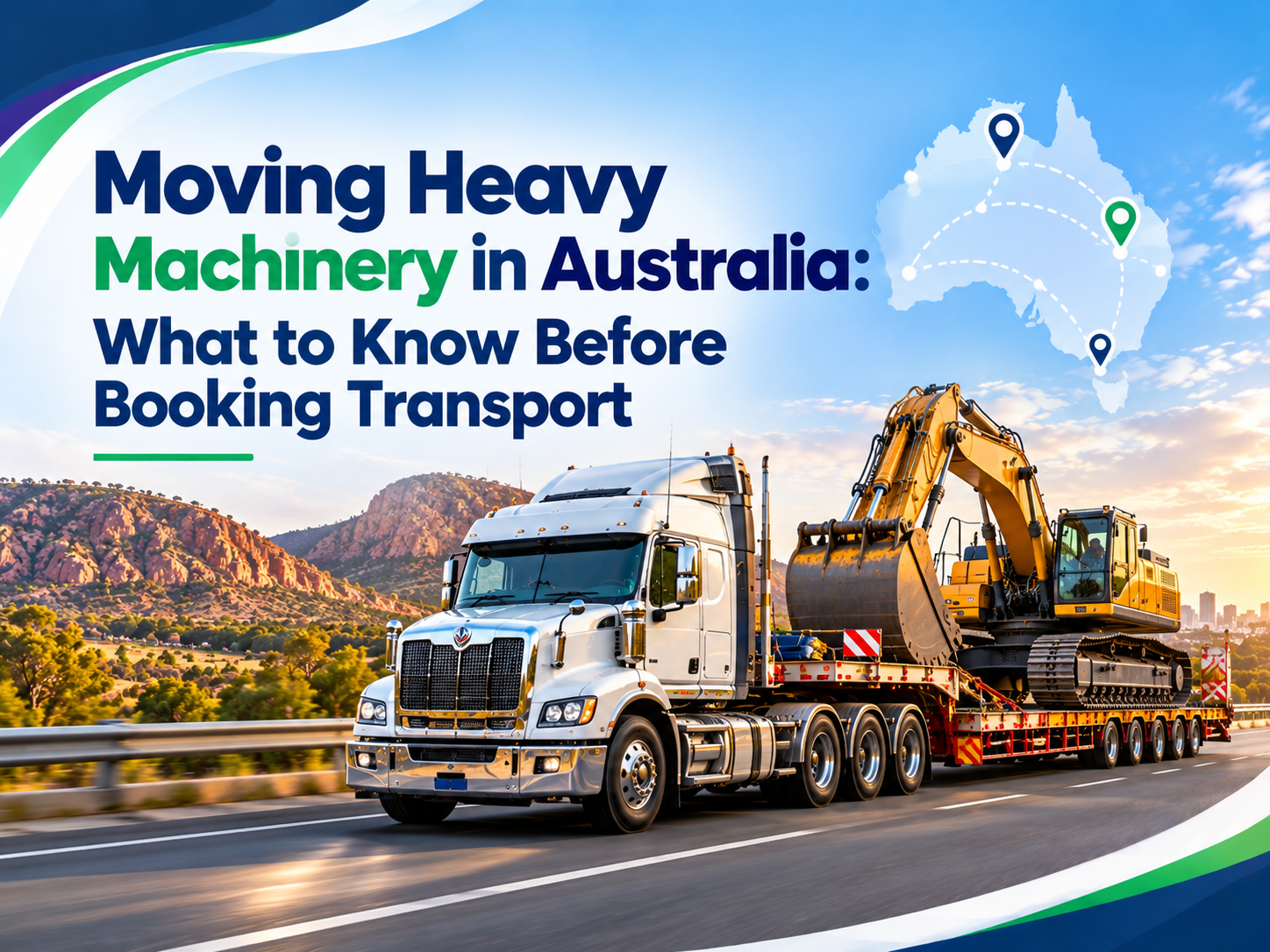
A 20-tonne excavator does not become a simple freight job just because the destination is known.
The machine might be sitting at a construction site outside Melbourne, ready to move to another project in regional Victoria. On paper, the job looks like a pickup and delivery.
In reality, the transport provider still needs to know whether the excavator is actually 20 tonnes in its current configuration, what attachment is fitted, whether it can load itself, how wide and high it is, and whether the trailer can physically get into the site. A narrow gate, soft ground, a non-running machine or an attachment that adds another metre to the overall width can change the transport requirements considerably.
For longer or larger movements, there is another layer to consider. The machine has to be assessed as part of the complete heavy vehicle and load combination, including its dimensions, mass and proposed route. Depending on the movement, that can bring road access restrictions, OSOM requirements or additional planning into the picture.
This is why the most useful information is often the information that gets overlooked when a machinery movement is first organised. Before asking a transport provider to quote, there are several details worth confirming about the machine, the loading site and the journey itself.
1. Start With the Machine
The first step is to establish exactly what will be put on the road. A machine's model number and published specifications provide a starting point, but the transport provider needs to know its actual weight and dimensions in the configuration in which it will travel.
For example, an excavator should not simply be described as “a 20-tonne machine”. Confirm the current operating or transport weight, what attachments are fitted and the machine's overall dimensions. Manufacturer specifications, weighbridge records or other reliable weight information are preferable to an estimate where they are available.
|
Information |
What to Provide |
Why it Matters |
|
Weight |
Actual operating/transport weight, including relevant fitted equipment |
Helps assess payload, mass limits and suitable equipment |
|
Length |
Overall transport length |
Contributes to trailer requirements and vehicle/load length |
|
Width |
Widest point, including attachments |
Important for equipment selection, access and oversize assessment |
|
Height |
Highest point in transport configuration |
Relevant to overall vehicle height and route clearances |
|
Ground clearance |
Clearance at the lowest relevant point |
Can affect loading arrangements and trailer suitability |
|
Attachments |
Type and configuration of fitted attachments |
Can change mass, dimensions and loading requirements |
If components such as a bucket, blade, boom or counterweight will be removed, folded or repositioned for transport, that should be specified rather than assumed.
For Australian road transport, the assessment concerns the heavy vehicle and its load as a complete combination when determining applicable mass and dimension requirements. Getting the machine's actual transport configuration right at the quoting stage therefore gives the carrier a much more reliable basis for assessing the movement.
2. Check How It Will Be Loaded
Once the machine itself has been properly described, the next question is how it will get onto the transport vehicle. This is where the machine's operating condition becomes important. Saying that equipment is “running” does not necessarily mean it can be loaded under its own power.
A machine may start but have failed steering, tracks, hydraulics or brakes, or be unable to position its attachment safely. Those details can change the loading method and should be disclosed before the truck is dispatched.
|
Machine Condition |
Potential Loading Implication |
|
Operational |
May be able to drive or track onto the trailer, subject to suitable loading equipment and site conditions |
|
Operational with limitations |
The specific fault may require another loading arrangement |
|
Non-running |
May require lifting, winching or other specialised loading arrangements |
The loading arrangement also needs to leave the machine safely positioned and appropriately restrained for transport. The specific restraint method depends on the machine, its configuration and the vehicle being used, so the carrier should assess these requirements as part of the loading plan.
The site also needs to support the chosen method. A machine being lifted may require suitable space for lifting equipment to set up, while self-loading requires enough room to position the trailer and use ramps safely. Ground condition, slope and available working area can all become relevant.
It should also be clear who is providing the loading and unloading equipment and personnel. A transport provider supplying the trailer does not necessarily mean they are responsible for arranging a crane or site loading crew. That should be agreed before the movement is booked, particularly where a non-running machine is involved.
3. Check the Pickup and Delivery Sites
A street address tells the carrier where the machinery is, but not whether the required vehicle and trailer can reach it, manoeuvre into position and leave after loading. This is particularly important at farms, construction sites, quarries, workshops and industrial properties where the final access can be very different from the main road.
|
Access Consideration |
What to Confirm |
|
Road approach |
Narrow sections, tight turns, steep grades, unsealed roads or other restrictions |
|
Property entrance |
Gate width, height and clearance around the entrance |
|
Manoeuvring space |
Room for the vehicle and trailer to turn, reverse or align with the loading area |
|
Surface and ground |
Whether access and loading areas are firm enough for the planned vehicle and operation |
|
Gradients |
Steep approaches, crossfalls or changes in level that may affect access |
|
Overhead clearance |
Trees, structures, signs and powerlines |
|
Loading area |
Space and surface conditions required for the agreed loading method |
Check site access against the vehicle you expect to use. A property may be easy for a rigid truck to enter but unsuitable for a longer trailer combination. Even if the vehicle can reach the property, it still needs enough room to turn, reverse and line up with the loading area.
If the approach is tight or unusual, send the carrier photographs of the road, entrance and loading area before booking. Point out anything that could restrict the movement, including low structures, trees or overhead powerlines. Don't leave the driver to discover an access problem when the truck arrives.
4. Make Sure the Equipment Fits the Movement
The carrier can assess the transport equipment once they know the machine's weight, dimensions, configuration, loading method and site access. Don't select a trailer simply because it can carry the machine's weight. Its dimensions, ground clearance and loading requirements also need to suit the movement.
A low-loader or drop-deck may suit one machine, while another may require different equipment because of its height, undercarriage or loading method. The carrier also needs to consider how the machine will sit on the trailer and how the loaded combination affects overall dimensions and mass distribution.
For shippers, the practical step is to provide accurate machine and site information rather than nominate a trailer unless they already know what the movement requires. The transport provider can then assess the equipment against the actual load, loading conditions and proposed movement.
5. Consider Oversize and Route Requirements
Once the machine is loaded, the carrier needs to assess the complete heavy vehicle and load combination, not just the machinery itself. Its final width, height, length and mass help determine whether the loaded combination qualifies for general access or must operate under a specific notice, permit or other access arrangement.
This becomes particularly important when the loaded combination exceeds the dimensions or mass permitted for general access. A machine can be within its published dimensions yet form part of an oversize movement once it is loaded, because the relevant assessment considers the complete vehicle and load.
For a machinery movement, the carrier should check:
-
Width and height: Will the loaded combination clear the available route, including structures and other overhead restrictions?
-
Length: Can the combination negotiate the route and relevant turns?
-
Mass: Does the loaded vehicle comply with the applicable mass limits for that combination?
-
Route: Are there bridge limits, restricted roads, tight intersections or other access constraints?
-
Access conditions: Does the movement operate under an applicable notice, or does it require a permit and specific conditions?
-
Pilot or escort requirements: Do the dimensions, route and applicable access conditions require additional vehicles?
The Australian rules also changed recently. From 1 August 2026, amendments to the Heavy Vehicle National Law and Mass, Dimension and Loading Regulations changed the general mass and dimension framework. The changes include higher General Mass Limits in specified cases and an increase in the general heavy vehicle length limit from 19 m to 20 m where the relevant requirements are met.
For OSOM movements, NHVR currently provides access through notices and permit-based arrangements, with conditions varying by vehicle, load, jurisdiction and route. Some movements require pilot or escort vehicles.
Give the Carrier the Information They Need
Before requesting a machinery transport response, give the carrier enough information to assess the movement without relying on assumptions. In Australian freight, that matters because a machinery job can involve long distances, regional access, specialised equipment and route requirements that are difficult to resolve once a vehicle is already committed.
Before you request a machinery transport response, have the following information ready:
Machine
-
Actual operating or transport weight
-
Overall length, width and height
-
Ground clearance
-
Attachments and transport configuration
-
Whether the machine is operational, limited or non-running
Loading and Unloading
-
How the machine will be loaded and unloaded
-
Whether ramps, a crane or winching will be required
-
What loading equipment or personnel are available at each site
-
Any limitations affecting the machine's ability to move into loading position
Pickup and Delivery
-
Full pickup and delivery locations
-
Access-road and property restrictions
-
Gate and manoeuvring dimensions where access is tight
-
Ground and surface conditions
-
Low structures, trees or overhead powerlines
Supporting Information
-
Clear photographs of the machine and attachments
-
Photos of the approach, entrance and loading area
-
Manufacturer specifications or reliable weight documentation where available
For shippers, providing this information early reduces the need for carriers to make assumptions about equipment, loading or access. For carriers, it provides the information needed to assess the movement, identify constraints and determine whether further route, access or loading checks are necessary.
In a country where machinery may move between metropolitan projects, regional sites and remote properties, that information can make the difference between a straightforward movement and a problem discovered after the truck is already on its way.
Arrange Your Machinery Movement Through Freightland
A well-specified machinery movement gives both sides a better starting point. Freightland Carriers Australia connects shippers with registered transport companies and owner-drivers through a freight marketplace, allowing the relevant machine details, loading requirements, access conditions and photographs to be shared upfront.
Shippers can compare carrier responses against the requirements of the movement, while carriers can identify freight that matches their equipment, operating capabilities and available capacity. This makes it easier to assess a potential movement before committing to the transport arrangement.
Post your machinery requirement and compare carrier responses through Freightland.