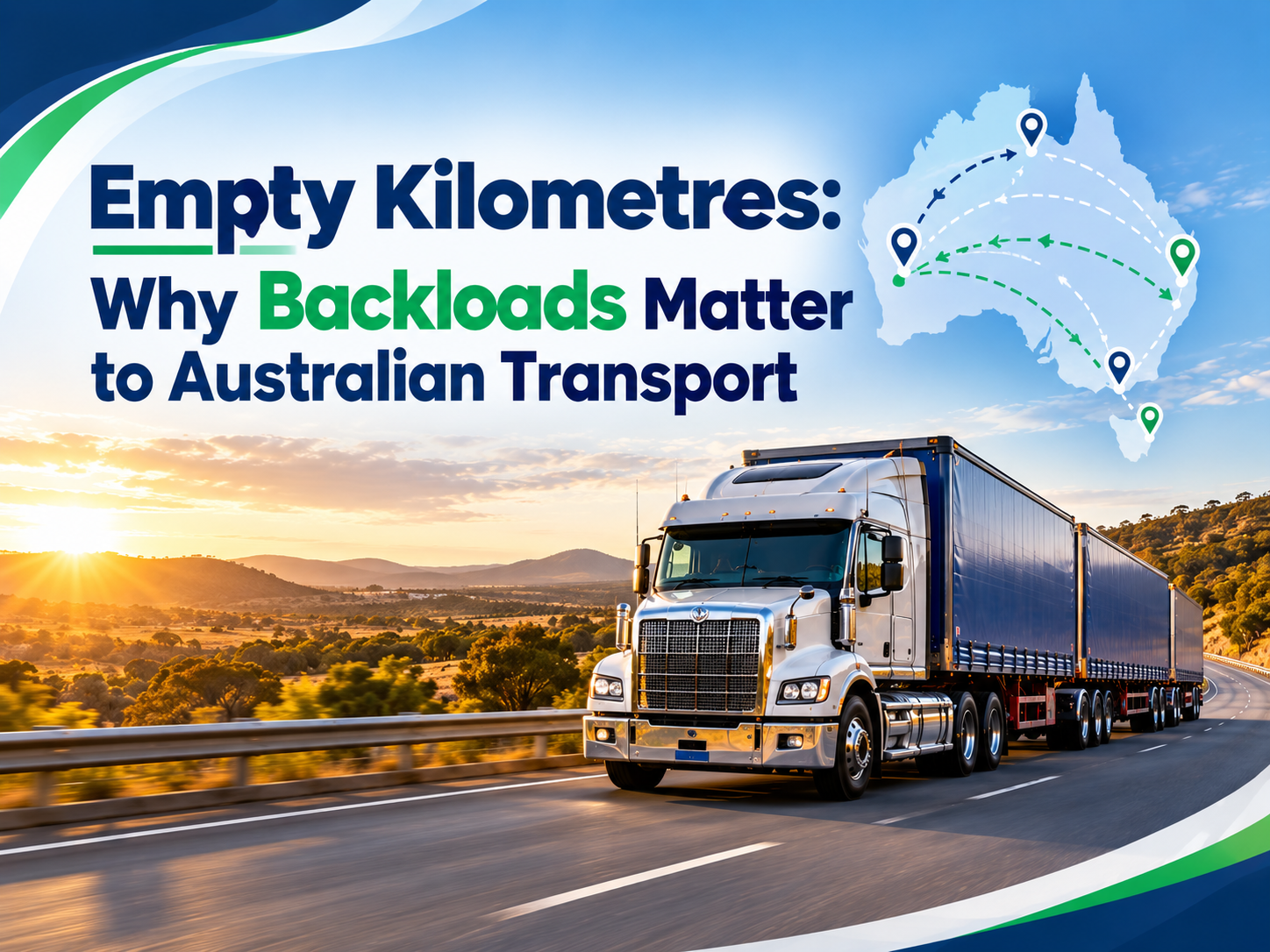
A truck can finish a delivery and still have a very expensive journey ahead of it. The freight may be gone, but the diesel is still being burned, the driver is still on the clock, tyres are still turning and the truck and trailer are still tied up. On a long interstate run, hundreds of kilometres without another load can turn otherwise productive equipment into a costly repositioning movement.
Yet the answer is not simply to find something to put on the truck.
A load that requires a major detour, unsuitable equipment, long waiting times or disrupts the next job can create more problems than it solves. That is why backloading is really a question of matching:
Can freight that needs to move be fitted into capacity that is already moving, at the right time, on the right route and with the right equipment?
When that match works, an empty return leg can become productive capacity for the carrier and a practical transport opportunity for the shipper.
Why Empty Kilometres Happen in Australian Freight
The challenge is that Australian freight does not move in neat pairs. A truck may carry manufactured goods from Melbourne to Brisbane, only to find that far less freight is moving south when the delivery is complete. The same imbalance can occur when a vehicle serves a regional or remote destination and its next suitable load is some distance away. On major interstate corridors, freight demand can also shift with the commodity, route and season.
CSIRO's freight benchmarking work reflects this variation, finding that backload potential differs substantially by commodity and route, with general freight between major centres offering greater opportunities than some bulk freight movements.
That does not mean every empty kilometre represents poor utilisation.
A carrier may deliberately reposition for its next job, return to its operating base or travel empty to meet an existing customer commitment. The more useful question is whether otherwise unavoidable movement contains capacity that could be put to productive use. That is where suitable backloads become relevant.
How Backloads Make Existing Transport Capacity More Productive
If some empty running is unavoidable, the opportunity is to make better use of the capacity that is already on the road. That is where a backload can change the economics of an existing journey without requiring the carrier to build an entirely new movement around it.
A Backload Uses an Existing Movement
Take a truck that has carried freight from Melbourne to Brisbane. Once that delivery is complete, the carrier may already be planning to head back towards Melbourne. If suitable freight needs to move in the same direction, that return journey could become a productive part of the truck's next movement rather than simply a repositioning trip.
For the shipper, this can create another transport option. For the carrier, it can make better use of a truck, trailer and driver that are already committed to the route.
An Empty Truck Still Has Operating Costs
The vehicle does not stop costing money when the freight comes off. Fuel is still being used, the driver is still working and the truck and trailer are still accumulating wear and consuming valuable operating time.
But there is an important catch: an empty truck is not automatically a truck with spare capacity.
A trailer may have room but not enough remaining payload. The freight may require different equipment, take too long to load or involve a pickup well outside the carrier's planned route. Timing can create the same problem if the additional job interferes with the next scheduled movement.
A backload therefore has to fit more than the available space. It has to fit the vehicle, route, timing and wider operation.
What Makes a Backload a Good Match?
A backload becomes useful when it can slot into a movement that is already happening without turning that movement inside out. A carrier planning a Brisbane–Melbourne return, for example, is not simply looking for freight that ends in Melbourne. The pickup, loading time, vehicle configuration, remaining mass, road access and delivery window all have to work around the trip already on the books.
Route Alignment
The city pair is only the first check.
A pallet shipment from a Brisbane industrial estate may be an easy pickup for a truck already leaving the area. A load 80 or 100 kilometres away can be a different proposition if reaching it means leaving the planned corridor, adding several hours and then getting back on route.
The same applies at the delivery end. A carrier may be heading towards Melbourne but have a scheduled delivery in the western suburbs, while the backload requires access to a site well outside that movement. A backload works best when the freight sits naturally within the journey rather than requiring the journey to be rebuilt around the freight.
Capacity and Equipment
There are several different meanings of “room on the truck”.
A carrier may have spare floor space but limited remaining payload. A long piece of machinery may fit dimensionally but require a different trailer configuration or loading method. Freight already on the vehicle can also affect where another item can safely be positioned.
For Australian general freight, that might mean assessing whether pallets can be accommodated alongside the existing load. For machinery or vehicles, it can mean checking dimensions, loading access, ramps or lifting equipment before the job is accepted.
Thus, the question is not simply “Can it fit?” but “Can this vehicle carry it as part of the movement?”
Timing and Schedule
Backloads work around an existing schedule, so timing can be more important than distance.
A carrier may already have a delivery appointment, another pickup booked after the return leg, or a driver whose available work time limits how long the vehicle can wait. A shipper offering a genuine pickup window rather than insisting on one precise appointment can sometimes make a return load much easier to accommodate.
That flexibility is particularly useful when freight is moving between major distribution areas and regional sites, where loading or unloading times can be less predictable.
Loading, Unloading and Site Conditions
The freight can fit the trailer and still be the wrong job.
A pickup requiring a crane when the carrier has no suitable lifting arrangement, a site that cannot accommodate the vehicle, or several hours of waiting for loading can undermine an otherwise promising backload.
This is why information about forklift availability, docks, cranes, access restrictions and driver loading requirements matters before the carrier commits to the movement.
Does it Make Sense for the Whole Trip?
Finally, the carrier has to look beyond the additional load.
If taking it means a substantial detour, extra tolls, lengthy waiting or missing the next scheduled job, filling the available space may actually make the overall operation less efficient.
That is the distinction between a backload opportunity and simply putting more freight on a truck. The objective is not to fill every empty space at any price but to use capacity that is already moving when the additional freight makes operational and commercial sense.
How Shippers Can Make Their Freight Easier to Match
Now that you know why a carrier needs more than a city pair before deciding whether a backload works, you should know that the same principle applies to the freight description. “Three pallets from Brisbane to Melbourne” is a starting point, but it’s not enough information to properly assess a return movement.
Here are the details that are genuinely helpful:
|
What to Provide |
What the Carrier Needs to Understand |
|
Freight type and quantity |
What is being moved and how many units, pallets or items are involved |
|
Weight |
Total weight and, where relevant, how the weight is distributed |
|
Dimensions |
Length, width and height, including anything that protrudes or cannot be stacked |
|
Pickup and delivery locations |
The actual site or address, not just the city or postcode |
|
Ready and required times |
When the freight can be collected and when it needs to arrive |
|
Loading arrangements |
Whether a forklift, dock, crane, ramps or driver assistance is required |
|
Site access |
Any vehicle restrictions, tight access, construction-site conditions or other constraints |
|
Special requirements |
Refrigeration, dangerous goods, oversize, machinery, vehicles or other handling and compliance needs |
|
Photos or supporting documents |
Particularly useful for unusual freight, machinery, awkward loads or complex pickup sites |
If the freight genuinely has some timing flexibility, make that clear. A carrier may be able to work a collection across a wider window into an existing run more easily than a fixed appointment, although flexibility does not guarantee a match.
For carriers, this information allows a potential backload to be screened before the vehicle is committed. For shippers, accurate details reduce the risk of discovering at pickup that the freight, access conditions or handling requirements are different from what the carrier expected. If a detail could change the vehicle, route, loading method or time required, include it in the freight description.
When a Backload isn't the Right Option
The fact that a truck has available capacity does not make every shipment suitable for its return journey. Sometimes the constraints of the freight or the existing movement make a dedicated transport job the more sensible option.
A backload may be unsuitable when:
-
The delivery deadline leaves little room to work around the carrier's existing schedule
-
The pickup or delivery requires a substantial diversion from the planned route
-
The freight needs a vehicle, trailer or loading equipment that is not available
-
Oversize or specialised freight requires permits, escorts or a specific transport configuration
-
Temperature-controlled freight cannot be carried with the required refrigeration arrangements
-
Dangerous goods requirements are not compatible with the proposed movement
-
Loading, unloading or site access is likely to create excessive delay
-
Adding the freight would interfere with an existing load or the carrier's next scheduled job
In these situations, trying to fill unused capacity can defeat the purpose of backloading. The most efficient transport option is the one that works for the whole movement, whether that means using return capacity or arranging a dedicated load.
Backloads Still Have to Meet Australian Safety and Compliance Requirements
A return load does not get a free pass on the usual heavy-vehicle requirements. Before a carrier takes it, the freight still needs to work with the vehicle, the load needs to be properly secured, and any requirements attached to the freight or route need to be understood.
For example:
-
Weight and dimensions: The carrier needs reliable information to determine whether the freight can be carried safely with the existing load and vehicle.
-
Loading and restraint: The additional freight needs to be loaded, positioned and restrained correctly. The NHVR Load Restraint Guide provides guidance on securing heavy-vehicle loads.
-
Vehicle and equipment: A backload may not work if the available truck or trailer is unsuitable for the freight or if additional loading equipment is needed.
-
Specialised freight: Oversize loads, dangerous goods and other freight with specific requirements may need additional planning, equipment, permits or approvals.
-
Chain of Responsibility: The responsibilities do not sit with the carrier alone. Depending on their role in the movement, shippers and other parties can have CoR duties as consignors, packers, loaders or schedulers.
The important point is that booking freight onto a return movement does not change who is responsible for the work they undertake. The shipper remains responsible for the parts of the process it controls, the transport provider for its transport operations, and the role of Freightland Carriers Australia is to facilitate the connection rather than operate the movement itself.
How Freightland Helps Find Suitable Return Capacity
The difficulty with backloads is often not the lack of capacity or freight. It is that the two are not always visible to each other at the right time.
For Shippers
A business with freight that can move on a flexible schedule can post the details carriers need to assess whether it fits an existing movement. Comparing responses gives the shipper a way to consider different transport options rather than arranging a separate vehicle without knowing what return capacity may be available.
For Transport Providers
For carriers and owner-drivers, a marketplace can provide visibility of freight that may fit an existing route or available capacity. They can assess each opportunity against their vehicle, schedule, route and the commercial realities of taking the load, rather than committing simply because space is available.
The value is in bringing those two sides together. A carrier can have capacity without knowing that suitable freight is available, while a shipper can have flexible freight without knowing which providers have room on a relevant movement.
That is where a freight marketplace can help. Freightland connects shippers with registered transport providers so potential backloads can be assessed against the actual freight, route, timing and equipment involved.
For shippers, the next step is to post a freight requirement with enough detail for carriers to assess the opportunity. For carriers and owner-drivers, it is to identify freight that genuinely fits the capacity and movements already in their operation.